'/%3e%3crect%20x='0'%20y='0'%20width='200'%20height='100'%20rx='44'%20fill='%23FFFFFF'%20opacity='0.05'/%3e%3cpath%20d='M66%2042%20h68%20a20%2020%200%200%201%2020%2020%20v46%20a20%2020%200%200%201%20-20%2020%20h-46%20l-24%2021%20v-21%20h2%20a20%2020%200%200%201%20-20-20%20v-46%20a20%2020%200%200%201%2020-20%20z'%20fill='%23FFFFFF'/%3e%3cpath%20d='M74%2087%20L94%20107%20L132%2065'%20fill='none'%20stroke='url(%23check)'%20stroke-width='13'%20stroke-linecap='round'%20stroke-linejoin='round'/%3e%3c/svg%3e)
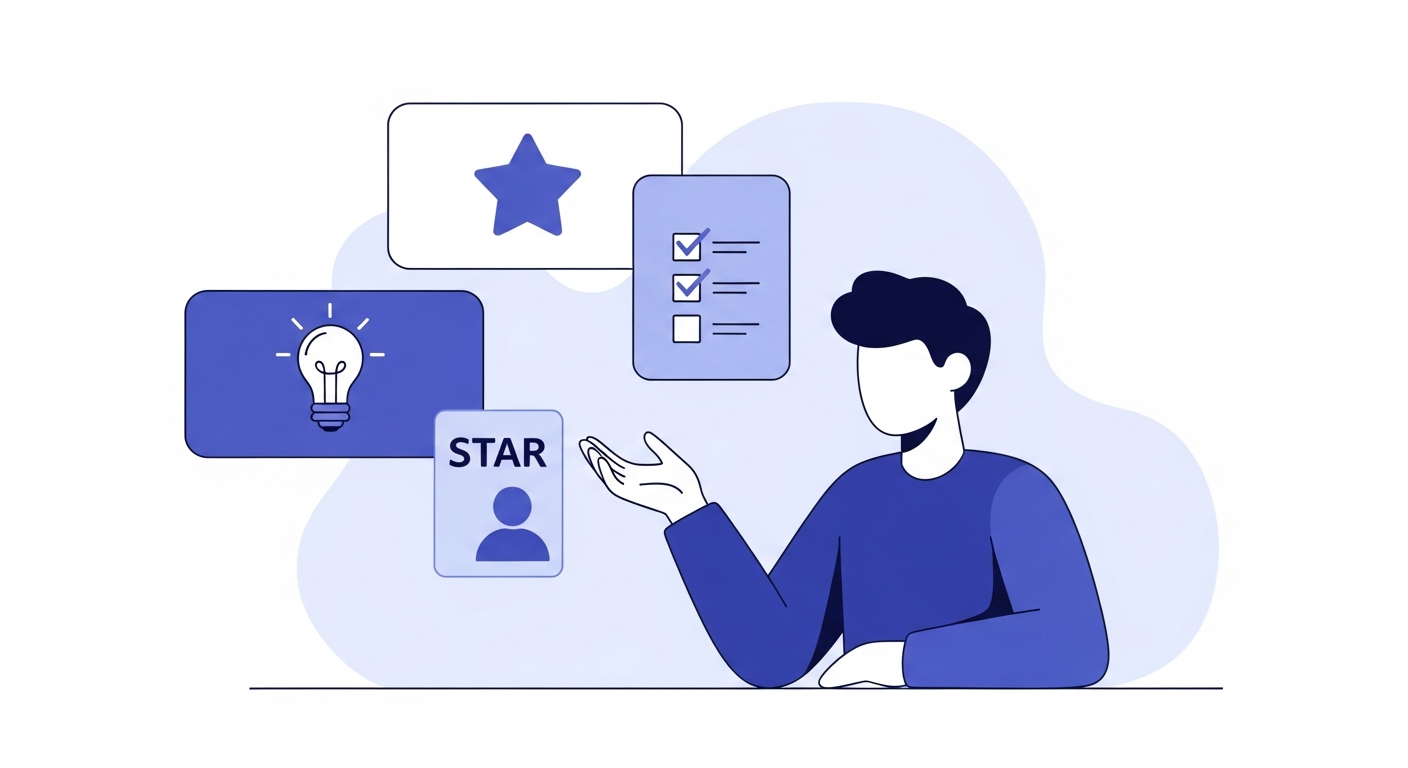
Behavioral interview questions — the "tell me about a time when..." questions — decide more hiring outcomes than any other question type. Interviewers use them because past behavior is the best available predictor of future performance, and because they're hard to fake without preparation.
The good news: behavioral questions are the most predictable part of any interview. A relatively small set of questions covers the vast majority of what you'll be asked. Prepare strong, true stories for the ten questions below and you'll be ready for almost any behavioral round.
First: the STAR method in 60 seconds
Every answer below uses the STAR structure:
- Situation — one or two sentences of context. Where were you, what was at stake?
- Task — what specifically were *you* responsible for?
- Action — what did you actually do? This should be the longest part.
- Result — what happened? Quantify it if you possibly can.
The most common failure mode is spending 80% of your answer on Situation and rushing the Action and Result. Aim for the opposite: brief setup, detailed actions, concrete outcome.
1. "Tell me about a time you faced a difficult challenge at work."
Why they ask: They want to see how you behave under pressure and whether you take ownership or deflect.
How to answer: Pick a genuinely hard, high-stakes situation where you drove the resolution. Emphasize your reasoning process, not just the outcome.
Example shape: "Our largest client threatened to leave after a botched delivery (Situation). As account lead, I owned the recovery (Task). I flew out within 48 hours, presented a root-cause analysis and a revised delivery plan with weekly checkpoints (Action). The client renewed for two more years and later became a reference account (Result)."
2. "Tell me about a time you failed."
Why they ask: To test self-awareness and whether you learn from mistakes.
How to answer: Choose a real failure — not a humble-brag like "I worked too hard." Own it plainly, then spend most of your answer on what you changed afterward. End with evidence the lesson stuck.
3. "Describe a conflict with a coworker and how you handled it."
Why they ask: Every team has friction. They want evidence you handle it professionally rather than avoiding it or escalating it.
How to answer: Frame the conflict as a disagreement about the work, not personalities. Show that you sought to understand the other side first, found common ground, and preserved the relationship. Never trash the other person.
4. "Tell me about a time you led a team or project."
Why they ask: Even for non-management roles, they want signal on initiative and influence.
How to answer: Leadership doesn't require a title. Describe how you set direction, unblocked others, and kept people aligned. Include one moment of adversity — leadership stories with zero friction sound invented.
5. "Describe a time you had to work under a tight deadline."
Why they ask: To see how you prioritize and whether you communicate proactively when time is short.
How to answer: The strongest answers show *triage*: what you cut, what you kept, and how you told stakeholders early. Delivering everything by heroically working all night is a weaker answer than ruthlessly prioritizing the 20% that mattered.
6. "Tell me about a time you disagreed with your manager."
Why they ask: They're probing for backbone-with-judgment: can you push back constructively and then commit?
How to answer: Show that you disagreed privately, with data, and in service of the goal — and that once a decision was made, you committed fully even if it wasn't yours. Bonus points if you were wrong and say so.
7. "Describe a situation where you had to learn something quickly."
Why they ask: Roles change fast; learning speed is a core hiring signal.
How to answer: Pick something with a real deadline. Describe your learning *system* — how you found the best resources, who you asked, how you validated your understanding — rather than just "I studied hard."
8. "Tell me about a time you went above and beyond."
Why they ask: To find evidence of ownership beyond your job description.
How to answer: The key is that nobody asked you to do it. Spot a problem, take initiative, deliver measurable value. Keep it humble in tone — let the result do the bragging.
9. "Describe a time you had to persuade someone."
Why they ask: Influence without authority is essential in almost every role.
How to answer: Show that you understood the other person's incentives first, tailored your argument to *their* priorities, and used evidence rather than pressure. The result should be genuine buy-in, not grudging compliance.
10. "Tell me about a time you received difficult feedback."
Why they ask: Coachability. People who react defensively to feedback are expensive hires.
How to answer: Name the feedback specifically, describe your honest first reaction, then show the concrete change you made and the improved outcome. Vague answers ("I always welcome feedback!") score poorly.
Preparing your story bank
You don't need ten separate stories. Most candidates can cover all ten questions with four to six strong stories, each adaptable to multiple questions. Build your bank like this:
1. List your 4–6 most significant professional experiences (projects, crises, wins, failures)
2. Write each one in STAR format — bullets, not scripts
3. Map each story to the questions above; fill gaps with additional stories
4. Practice telling them out loud. A story you've only written down will come out twice as long and half as clear when spoken.
That last step is where most preparation falls apart. Reading your STAR bullets silently feels like preparation, but interviews are a spoken performance. The candidates who sound polished have rehearsed out loud — either with a friend, a coach, or an AI mock interviewer that asks the questions unpredictably and scores the answers.
Practice these questions in a real mock interview
The fastest way to pressure-test your story bank is a realistic voice interview. Botreadyme generates behavioral questions tailored to your target job description and your actual resume, conducts the interview live by voice, and gives you per-answer feedback with model answers — so you can see exactly how your STAR stories land before the interview that counts. Your first 30 minutes are free.
Ready to practice for real?
Paste your job description, upload your resume, and take a live AI mock interview with detailed feedback. Your first 30 minutes are free.
Start Practicing Free